
Buying AI Won’t Transform Your Recruitment Business
Recruitment businesses are investing heavily in AI, but there is still a significant gap between buying technology and changing the way an agency actually operates.
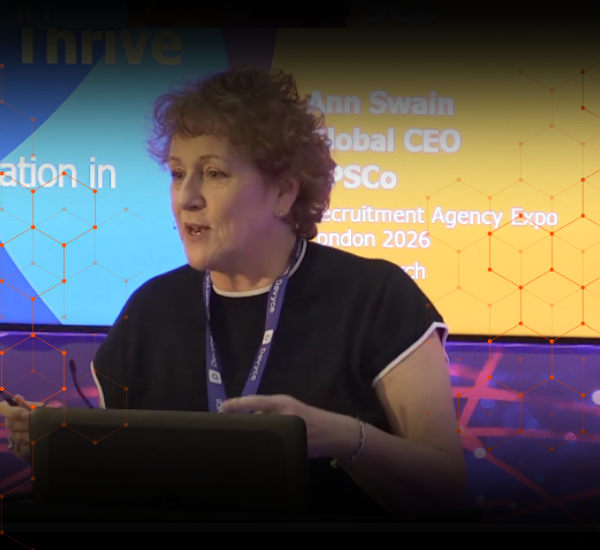
At Recruitment Agency Expo London on 18 March 2026, Ann Swain, Global CEO of APSCo, took to the Evolve Stage to deliver Transform, Diversify, Thrive & Survive: A Strategic Blueprint for Recruitment Businesses. Her session explored the pressures facing recruitment leaders and the decisions businesses need to make as technology, client expectations and the wider market continue to change.
AI was central to that discussion. Swain highlighted APSCo research showing that 66% of recruitment businesses had undertaken structured AI trials and 60% were increasing their technology investment, while fewer than a quarter of individual recruiters were using AI within their everyday workflows. The figures point to an important challenge for recruitment leaders: technology may be entering the business faster than it is becoming part of the way people work.
AI Adoption In Recruitment Requires More Than TechnologyOne of the themes Hurley returned to was the tendency for businesses to approach AI as a series of individual technology purchases. As she described it, “they’re buying the bits”, introducing tools into different areas without necessarily stepping back and looking at how the whole recruitment process could work differently.
Her advice was to start with the workflow rather than the product. “Instead of dabbling, work through your workflows on how you can streamline things.” For recruitment businesses, that means looking closely at where consultants spend their time, which processes are repeated unnecessarily and which tasks can be handled more efficiently without losing the human judgement that recruitment depends on.
There are already obvious opportunities. Hurley highlighted transcription and call recording alongside CV formatting and candidate profile creation, while AI is increasingly being used across search, market mapping, sourcing, screening, assessment, onboarding, compliance and business development. Individually, these applications may save relatively small amounts of time, but across an agency they have the potential to change where recruiters focus their attention.
How AI Is Changing The Role Of RecruitersFor recruiters who entered the industry because they enjoy working with people, greater automation could bring the role closer to the parts of recruitment they value most. Swain argued that technology can remove more of the administrative burden and allow recruiters to “focus on the people part of the job”.
However, removing routine work also changes what businesses need from their recruiters. Relationship building, understanding a client’s commercial challenges, influencing decisions and advising candidates are considerably harder to automate, which means the human part of recruitment may become more important rather than less important as AI adoption increases.
As Swain put it, “The sexy bits of the job of a recruiter are the more complex bits.” Recruitment businesses therefore need to consider skills and development alongside their technology investment. If AI takes responsibility for more transactional work, agencies will need people with stronger judgement, communication skills and commercial understanding to handle the more complex work that remains.
“You need smart people. You need able people. Maybe smarter than you, maybe more able than you. That doesn’t make them a threat,” she said. For agency leaders, this raises a wider question about whether future growth will simply require more recruiters or a different type of recruiter altogether.
Leadership Is Critical To AI Transformation In RecruitmentTechnology can automate processes, analyse performance and support decisions, but Hurley was clear about one area where it cannot replace people. “That’s one thing that artificial intelligence will not do for you: lead your people.”
For Swain, leadership starts with having a clear “North Star” for the business and making sure people understand both where the organisation is heading and why. That becomes particularly important during technological change, when different employees may have very different levels of confidence and enthusiasm about adopting new ways of working.
Some recruitment leaders will naturally want to move quickly, while others may prefer to wait until the technology becomes more established. Hurley argued that successful change requires what she described as an “empathy-led” approach, recognising how people are responding and bringing them through the process rather than simply introducing new systems and expecting adoption to follow.
Measuring AI And Recruitment Performance DifferentlyIf technology changes the way recruiters work, Swain also believes agencies may need to reconsider how they measure performance. Traditional recruitment metrics remain important, but increased access to data gives businesses an opportunity to look more closely at customer experience, activity and the behaviours that create longer-term value.
“If I were running a recruitment company today, I would relook at my commission structure,” she said, raising the possibility of rewarding measures beyond placements and revenue. Customer experience, recommendation and other indicators of relationship quality could potentially form part of a wider picture of performance.
The principle behind this is straightforward: “If it’s worth doing, measure it.” The challenge for recruitment businesses is not simply collecting more information because technology makes it possible, but deciding which measures genuinely support the type of agency they are trying to build.
Building An AI Strategy For A Recruitment AgencyThe speed of change also makes traditional long-term planning more difficult. Swain questioned how useful a rigid three-year strategy can be when the technology and recruitment market are evolving so quickly, observing that “if you have a three-year plan, you’re going to change it 50 times”.
Rather than abandoning strategy, her argument was to keep the destination clear while remaining flexible about the route. A recruitment business can know what it stands for, which customers it wants to serve and what it is trying to achieve without assuming that the plan for getting there will remain unchanged for several years.
That flexibility also requires resilience. Recruitment businesses need enough financial and operational strength to experiment, learn and adjust when investments do not deliver exactly as expected. The agencies that benefit most from AI may not ultimately be those that buy the greatest number of tools, but those that understand the problems they are trying to solve, redesign their workflows accordingly and invest in the people who will make the technology useful.
AI can change how recruitment gets done, but turning that technology into a stronger recruitment business remains a leadership challenge.
Key Takeaways
- AI investment does not automatically translate into AI adoption across recruitment teams.
- Recruitment businesses should consider examining workflows and business problems before selecting technology.
- Automation can remove administrative work, but this increases the importance of recruiters’ relationship, communication and commercial skills.
- AI implementation needs to be treated as a leadership and people challenge - as well as a technology project.
- Recruitment businesses may need to rethink traditional performance measures as roles and workflows change.
- Agencies need a clear long-term direction while also remaining flexible about how technology helps them achieve it.
Recruitment Agency Expo London returns to ExCeL London on 16-17 March 2027, bringing recruitment leaders together with industry experts and technology providers to explore AI, RecTech, leadership and business growth.
Recruitment professionals can register their interest, while suppliers can enquire about exhibiting and partnership opportunities.